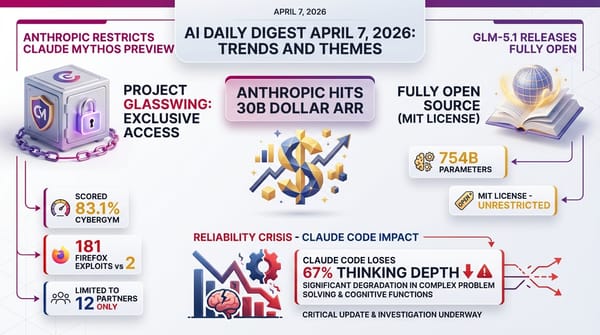
AI Daily Digest - 2026-04-08
Meta's New AI Model Is Here - and It's Not Open Source · Anthropic Launches "Managed Agents" - AI Agents as a Service · A Man Gave Claude His 30-Year-Old Game Files. A Weekend Later, It Was Alive Again.

1. One Thing to Tell Your Friends
Meta just released its first new AI model in a year - and for the first time ever, you can't download it for free. It's invite-only, hosted on Meta's servers, and only accessible through a Facebook or Instagram login. The company that made "open AI" its brand just went closed.
2. TL;DR
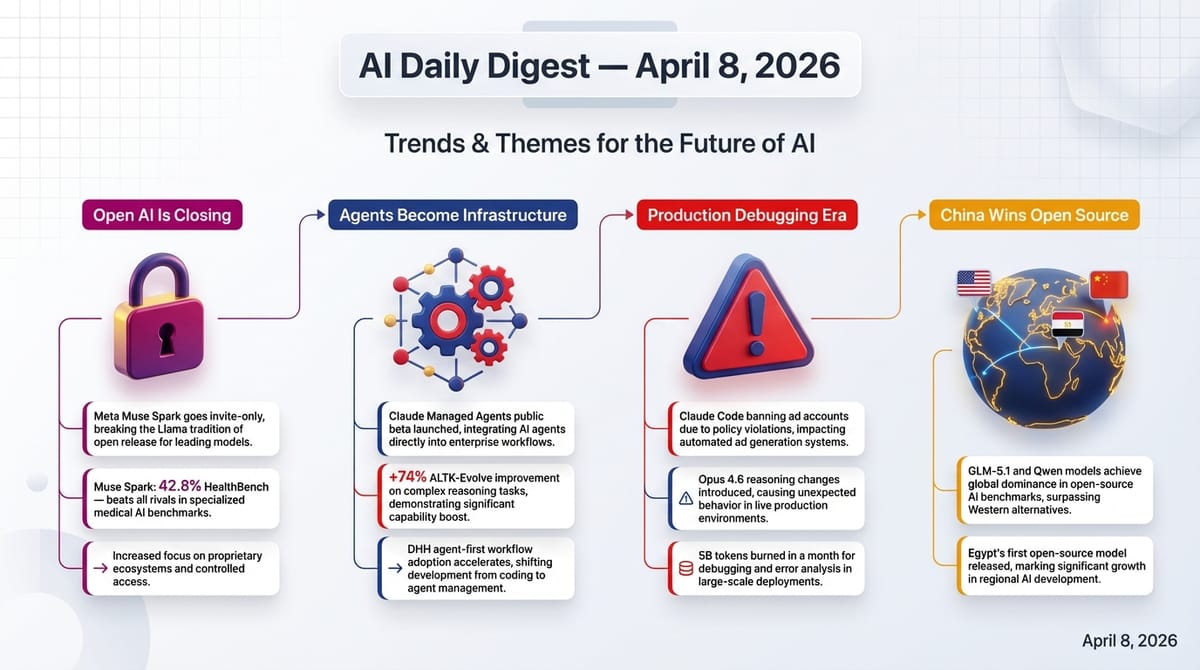
- Meta launched Muse Spark - first proprietary AI model from Meta, breaking the open-source Llama tradition; invite-only, accessible only via Facebook or Instagram login.
- Anthropic launched Claude Managed Agents in public beta - AI agents as a cloud service, so businesses can deploy persistent agents in days instead of months, at $0.08/hour plus model costs.
- A developer resurrected a 1992 multiplayer game using Claude Code - 2,273 rooms and 297 monster types rebuilt from documentation alone in a single weekend, no original source code required.
- DHH, creator of Ruby on Rails (the web framework), switched to AI agents as his primary dev tool - his finding: senior engineers benefit most from agent workflows, not least.
- LG AI Research released EXAONE 4.5, an open-weight vision-language model (a system that understands both images and text) in 33 billion parameters that outperforms GPT-5 mini across 13 visual benchmarks.
3. Top Stories
Meta's New AI Model Is Here - and It's Not Open Source
Muse Spark is Meta's most powerful AI model yet, built by a new lab under the leadership of Scale AI founder Alexandr Wang - and unlike every Llama model before it, you can't download and run it yourself.
Meta Superintelligence Labs launched Muse Spark today, billing it as their first frontier model on a completely new stack. The model is "natively multimodal" - meaning it can understand and work with text, images, and other inputs at the same time, rather than handling them separately.
Performance is legitimately competitive. On HealthBench Hard (a medical reasoning benchmark where AI tries to answer difficult clinical questions), Muse Spark scored 42.8% - better than Claude Opus 4.6, Gemini 3.1 Pro, and GPT-5.4. On CharXiv Reasoning, which tests how well AI interprets scientific figures and charts, Muse Spark scored 86.4 in Thinking mode, ahead of all major competitors. The trickier "Contemplating" mode, which spins up multiple AI reasoning agents in parallel, hits 58% on Humanity's Last Exam - one of the hardest general-knowledge benchmarks in existence.
- 42.8% on HealthBench Hard - beats all frontier rivals
- 86.4 on CharXiv Reasoning (Thinking mode)
- 58% on Humanity's Last Exam (Contemplating mode)
- Available at meta.ai with Facebook or Instagram login; Application Programming Interface (API) access is invite-only
Meta says pretraining improvements let Muse Spark reach comparable capabilities with "over an order of magnitude less compute" than Llama 4 Maverick. In plain terms: it's more efficient, not just more powerful. Simon Willison tested the model's tools and found 16 integrated capabilities including web search, a Python code interpreter, and a "visual grounding" tool that can locate individual objects in photos with extraordinary precision - down to individual whiskers on a cat.
The model has gaps. Meta explicitly flagged "long-horizon agentic systems and coding workflows" as areas where it underperforms compared to rivals. Those happen to be two of the fastest-growing use cases in enterprise AI.
The bigger story is what's missing: open weights. Meta's Llama models have been freely downloadable by anyone - a defining feature that made Meta the most developer-friendly of the frontier labs. Muse Spark breaks that tradition entirely. The Register put it bluntly: Muse Spark is "as open as Zuckerberg's private school."
Anthropic Launches "Managed Agents" - AI Agents as a Service
Anthropic is now offering to run your AI agents for you. No servers to manage, no infrastructure to configure - you describe what the agent should do, and Anthropic handles the rest.
Claude Managed Agents, now in public beta, is a cloud service where businesses can deploy AI agents that run persistently, scale automatically, and integrate with their tools and systems. Think of it like the difference between buying a car and hiring a driver: instead of figuring out how to set up and run your own AI agent infrastructure, Anthropic runs it for you.
What it includes: secure sandboxed code execution (so the agent can run code without risking your systems), automatic checkpointing (so long tasks don't lose progress if interrupted), scoped permissions (limits on what the agent can access), and persistent sessions that can run for hours or days. Developers define what the agent should do and what tools it can use; Anthropic's infrastructure handles the rest.
Access is through the Claude Console, Claude Code, or a new command-line tool (CLI) - a terminal-based interface for developers.
This puts Anthropic directly in competition with OpenAI, Google, and Salesforce for enterprise AI platform contracts. The key differentiator Anthropic is betting on: safety and reliability guarantees that enterprise IT departments require before letting AI agents touch internal systems.
Try it: Visit claude.ai/managed-agents and request access through the Claude Console.
A Man Gave Claude His 30-Year-Old Game Files. A Weekend Later, It Was Alive Again.
Jon Radoff used Claude Code to reconstruct his 1992 text-based multiplayer game - a complete game world with 2,273 rooms, 1,990 items, and 297 monster types - entirely from old documentation and game captures, with no original source code.
The project on r/ClaudeAI received 2,103 upvotes. Radoff had created Legends of Future Past, a MUD (Multi-User Dungeon - a text-based online multiplayer game popular before the internet went graphical), in 1992. It ran for years, then shut down on December 31, 1999, with the original source code lost.
What he had left: script files in a custom scripting language, a 1996 gameplay capture, a 1998 Game Master manual, and player documentation. What he was missing: any runnable code.
Claude Code reverse-engineered the custom scripting language by analyzing the surviving examples and documentation. It decoded the combat system from the manual, interpreted monster behavior profiles, and then rebuilt the entire game engine from scratch - in the Go programming language, with a React frontend and MongoDB database. A game that took a full team of developers and content creators years to build the first time was resurrected in a weekend.
As Radoff wrote: "A game that I originally coded over six months -with a whole team of Game Masters building the content over years -was resurrected in a weekend."
DHH Has Switched to AI Agents. This Is What Changed His Mind.
David Heinemeier Hansson - the creator of Ruby on Rails (the framework that powers a large chunk of the web), and a vocal skeptic of AI hype - now uses AI agents as his primary development tool. His explanation of why is worth reading.
DHH wrote about his shift in The Pragmatic Engineer newsletter, and it's a template many developers will recognize. He found AI autocomplete tools (the kind that suggest code completions as you type) "genuinely annoying" - they were helpful enough to distract but not reliable enough to trust. He remained skeptical.
What changed: agent-based workflows with powerful models. Instead of AI whispering suggestions, he runs a fast model (currently Gemini 2.5) and a powerful model (currently Claude Opus) simultaneously in terminal windows, with the text editor NeoVim for reviewing the diffs they produce. He describes it as "wearing a mech suit" - the work goes significantly faster, but he's still in control of every decision.
His key observations:
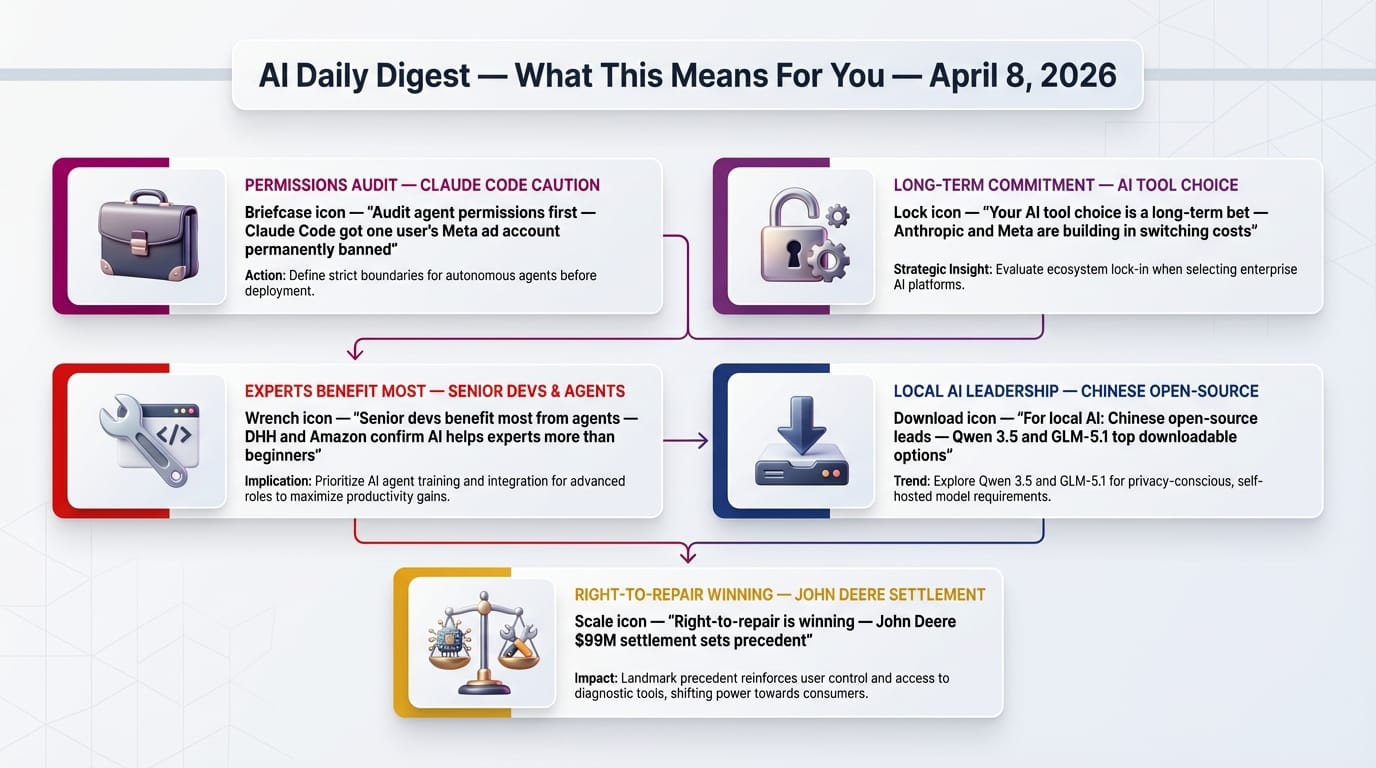
- Senior engineers benefit most. Experienced developers can validate agent outputs quickly. Junior developers often can't tell when the agent is confidently wrong. Amazon reached the same conclusion and restricted junior programmers from shipping agent-generated code without senior review.
- Beauty signals correctness. DHH argues that elegant code tends to be correct code - if agent output looks messy or complicated, it's a sign something's off. This gives experienced developers a fast intuition filter.
- Ruby on Rails is AI-friendly. Token-efficient syntax, built-in testing, and human-readable conventions make it ideal for agents to generate and humans to review.
One specific result: a project optimized the fastest 1% of server requests from 4 milliseconds to under 0.5 milliseconds - optimization work that would have been considered economically unjustifiable before, because the human time to do it would have cost more than the server savings.
512,000 Lines of Leaked Code Reveal How Anthropic Plans to Lock In Your Company
An accidental code leak exposed an Anthropic agent called Conway - and one newsletter's analysis argues it reveals a platform strategy designed to make switching away from Anthropic operationally painful in a way that pricing alone never could.
Nate's Newsletter examined the leaked codebase and argues Anthropic isn't building a chatbot company - it's building the "operating system" for enterprise AI. The analogy: just as Windows became indispensable by hosting applications, Conway is designed to become indispensable by hosting organizational memory.
Conway's architecture includes:
- A standalone agent environment separate from the regular Claude chat interface
- Event triggers that let external systems "wake up" the agent when something happens
- Browser control and integration with organizational tools
- Behavioral learning that accumulates context about your company's workflows over time
The lock-in mechanism isn't pricing. It's memory. Once an agent has spent months learning how your team works - your naming conventions, your decision patterns, which team members handle what - replacing it means starting that learning process over. The analysis draws a comparison to how Microsoft Office became entrenched: the files weren't portable in practice, even if technically they were.
Connecting today's news: Claude Managed Agents is a public step in this direction. Anthropic Cowork, Claude Code Channels, the Marketplace, and the Partner Network are the others.
4. Trends & Themes
Theme 1: "Open AI" Is Becoming a Selling Point, Not a Given
- Meta: first proprietary-only frontier model - Muse Spark is invite-only, hosted-only, and requires a Meta social media account. The Register: "as open as Zuckerberg's private school."
- Anthropic: 512,000 lines of code for an agent "OS" strategy - leaked Conway codebase and today's Managed Agents launch reveal a platform play built on owning infrastructure, not giving away models.
- OpenAI: 15 billion tokens per minute processed - enterprise is 40%+ of revenue and rising; $122 billion committed to AI compute capacity.
The trajectory: the leading AI labs are converging on infrastructure and platform ownership as their moat, not model capability or openness. What's harder to replicate is the data, the integrations, and the agents that have been learning inside your organization for a year.
Theme 2: AI Agents Are Becoming Real Infrastructure
- Claude Managed Agents gives enterprises sandboxing, persistent sessions, and checkpointing - the features IT departments require before approving any software for internal use.
- ALTK-Evolve from IBM Research gives agents persistent memory that improves with use - hard tasks improved 74% when agents could accumulate learned guidelines.
- DHH's agent-first workflow describes how a world-class developer has restructured his daily work around agents as his primary mode of development.
Each represents a different layer of the agent stack - runtime (Managed Agents), memory (ALTK-Evolve), and workflow integration (DHH's setup). When those layers combine in enterprise deployments, the productivity delta from AI will stop being marginal and start being structural.
Theme 3: The Production Debugging Era Has Begun
- A developer's Meta ad account was permanently banned by Claude Code making API calls (67 upvotes) that violated automation terms of service.
- Another developer burned 5 billion tokens with Claude Code in March (65 upvotes) building a financial application - an eye-watering expense reflecting how easily AI-assisted development scales costs.
- Opus 4.6's reasoning effort appears reduced (2,030 upvotes), extending yesterday's story about Claude Code's reduced thinking depth to the flagship model itself.
- A developer waited over a month for Anthropic support to respond (259 upvotes on HN).
These aren't isolated complaints - they're the predictable growing pains of technology moving from hobbyist to enterprise use. AI tools at this capability level can affect real production systems, real ad accounts, and real budgets when they make mistakes.
Theme 4: Chinese AI Labs Are Winning the Open-Source Race
Previously: April 7 - Z.ai released GLM-5.1, a 754-billion-parameter model under MIT license, the largest open-source AI model ever released.
- The ATOM Report highlights the "sheer dominance of Chinese labs" in open-source AI output.
- Three separate r/LocalLLaMA threads discuss Qwen 3.5 variants: a 122B model outperforming alternatives on Apple Silicon, an uncensored 35B variant (110 upvotes), and a cache reuse bug being tracked - the behavior of a mature, widely-deployed model.
- US labs are shifting to proprietary-only (Meta's Muse Spark, Anthropic's enterprise infrastructure), while Chinese labs continue releasing powerful models anyone can download, run locally, and modify freely.
5. Creative AI & Media
AI-Generated Images: How Far We've Come in 12 Years
A Reddit post on r/artificial with 832 upvotes compared an AI-generated cow image from 2014 - a blobby, barely recognizable quadruped - with what current generators produce. The 2014 image shows AI failing at basic object coherence. Today's tools handle accurate reflections, lighting, and texture at a level that went viral without needing explanation.
6. Developer Tools & Infrastructure
Railway Drops Next.js - Builds Drop From 10 Minutes to Under 2
Railway, a platform for deploying web applications, rebuilt its own frontend - replacing Next.js (a popular React framework from Vercel) with Vite plus TanStack Router. The results: build times dropped from over 10 minutes to under 2 minutes, done in two pull requests, with zero downtime.
Next.js is optimized for server-rendered pages - useful for blogs and e-commerce. Railway's product is heavily real-time (monitoring dashboards, live deployment logs, websocket connections), which Next.js handles awkwardly. The mismatch was costing developers 8+ minutes per build cycle.
The tech swap: Vite handles the build process and serves files with content-based fingerprints (so updating one feature only forces users to re-download that one chunk, not the whole application). TanStack Router handles navigation. Fastly replaced Next.js's image optimization. The post received 175 upvotes and 161 comments on Hacker News.
Try it: Vite is free and open-source at vitejs.dev. TanStack Router is at tanstack.com/router.
The pi Coding Agent Joins Armin Ronacher's Startup
If you've used Flask (a Python web framework), Jinja2 (a templating engine), or Click (a command-line tool builder), you've used Ronacher's work. He's built foundational tools that millions of developers rely on daily.
The announcement is explicit about what changes and what doesn't. The pi repository moves from Zechner's personal GitHub to Earendil's organization. The npm package name changes. pi.dev adds an Earendil logo.
What doesn't change: pi's MIT license, permanently. Zechner made this non-negotiable. Future commercial features will use Fair Source licensing (open-source with a time delay) or enterprise-only features - funding the free core without restricting it. The stated model: enable humans rather than replace them.
Zechner was burned by the acquisition of RoboVM, an open-source project he built that was acquired and then closed-sourced. He chose Earendil specifically because the team shares his philosophy. Having Ronacher's credibility behind that commitment matters.
Try it: pi is available at pi.dev - MIT licensed, free to use, fork, and build on.
IBM Research: AI Agents That Actually Learn From Experience
Most AI agents have a fundamental limitation: they don't improve from use. Every session starts fresh. The technical term for this is "eternal intern syndrome" - the agent re-reads transcripts of past interactions instead of developing generalizable knowledge.
ALTK-Evolve addresses this with a continuous learning loop. When an agent completes a task, the system extracts patterns from what worked and what didn't. Those patterns get scored and de-duplicated - weak rules get pruned, proven strategies get reinforced. The next time a similar task comes up, only the relevant guidelines are retrieved and injected into the agent's context.
Results on AppWorld, a benchmark for realistic multi-step tasks involving multiple APIs:
| Task difficulty | Without memory | With memory | Change |
|---|---|---|---|
| Easy | 79.0% | 84.2% | +5.2% |
| Medium | 56.2% | 62.5% | +6.3% |
| Hard | 19.1% | 33.3% | +74% relative |
The 74% relative improvement on hard tasks is the important number - exactly where you need agents to be reliable for production use.
Try it: Available on GitHub at AgentToolkit/altk-evolve with no-code integration for Claude Code users (simple plugin install) and API-level integration for custom agent builders.
Safetensors Is Now Community-Owned Infrastructure
Safetensors, the file format used by tens of thousands of AI models for safe, efficient storage, has been transferred from Hugging Face's ownership to the PyTorch Foundation - the same community governance structure that maintains PyTorch itself.
Quick background: when you download an AI model, the model weights (the numerical values that encode what the model knows) have to be stored in a file format. The old dominant format was based on Python's "pickle" system - which, by design, can execute code when a file is opened. Safetensors fixed this by using a format that physically cannot execute code, loads faster, and supports loading only specific parts of a model.
The governance transfer means no single company controls this format. Planned improvements: direct integration into PyTorch, support for loading models onto different hardware chips (CUDA for NVIDIA, ROCm for AMD), and formal support for compressed model formats.
7. Research & Models
OCR Is Getting a Major Upgrade - By Abandoning How Language Models Work
OCR - Optical Character Recognition - is the technology that converts images of text into actual text. It's how your phone can scan a receipt, or how a hospital converts paper records into searchable data. Every modern OCR system works the same way: it generates one word (technically one "token") at a time, left to right, top to bottom.
This has three problems. First, it's slow for long documents - every page requires thousands of sequential steps. Second, errors compound: if the system misreads an early word, it affects its guesses for later words. Third, and most interesting: the system "cheats." Because it's generating language, it uses knowledge about which words normally follow which other words - so it fills in what it expects to see rather than what's actually there.
MinerU-Diffusion from Shanghai AI Lab's OpenDataLab proves this with a clever experiment. They scrambled the text in documents - keeping the visual layout but randomizing the words - and tested two systems. Traditional OCR failed badly because the words no longer "made sense" linguistically. MinerU-Diffusion was unaffected because it reads visually, not linguistically.
Speed: 3.26 times faster than current tools. Accuracy: 99.9% relative to the best existing systems.
Gemma 4: Under the Hood
Google's Gemma 4 model family - covered in yesterday's digest as a new open-source release - got an architectural deep-dive today from machine learning researcher Maarten Grootendorst. The visual guide breaks down how the models actually work.
The key design choice: the models use a "sparse" approach called Mixture of Experts (MoE) for the largest variant (Gemma 4 26B A4B). Of the model's 26 billion parameters, only 4 billion are activated for any given input. This is like having a team of 26 specialists but only involving 4 of them for each task - you get the breadth of the full team's knowledge without the cost of involving everyone every time.
Compact variants (E2B/E4B) store per-layer embeddings on device flash storage rather than RAM - enabling more capable models to run on phones with limited memory.
Community update: r/LocalLLaMA discussions today showed ongoing issues getting Gemma 4 into the popular GGUF (compressed model) format for local use, with 406 upvotes on a thread tracking the llama.cpp pull requests needed to support it.
AI Gives Worse Information to the People Who Need It Most
This is a significant equity problem. LLMs (Large Language Models - the technology behind ChatGPT, Claude, and similar tools) are frequently marketed as democratizing tools, providing information access to people who couldn't otherwise afford doctors, lawyers, or financial advisors.
The reality, according to this research: the users who most need reliable AI-provided information - those least equipped to fact-check it independently, or access alternative expert sources - receive systematically worse outputs. The pattern held across three state-of-the-art models on two different datasets measuring truthfulness and factuality.
The mechanism isn't fully established. One likely factor: training data is overwhelmingly English-language and US-centric, so the models have weaker signal for interpreting non-standard phrasing or questions about non-US contexts.
Someone Put a Neural Network on a 1983 Commodore 64
The result works. It generates one word approximately every minute. The project on GitHub received 32 upvotes on r/LocalLLaMA. The model has 25,000 parameters - for reference, GPT-4 has roughly 1.8 trillion, making this implementation about 72 million times smaller.
The reason this is interesting isn't practical. It's architectural. The transformer design (the "T" in GPT) is elegant enough to implement on hardware 40 years old with 64 kilobytes of RAM. The gap between what's theoretically possible and what's computationally practical is entirely about hardware and data, not about the fundamental approach being right or wrong.
8. Business & Industry
OpenAI Enterprise Is Growing Fast - and Sora Is Gone
Codex - OpenAI's AI coding tool - now serves over 2 million weekly users, a 5x increase in three months. OpenAI's annualized revenue is above $25 billion, and the company is taking early steps toward a public stock listing, potentially as soon as late 2026.
The infrastructure announcement is the headline number: $122 billion committed to AI compute capacity. This is explicitly positioned as a barrier to competition - other companies can't match this level of infrastructure investment quickly.
Sora, OpenAI's video generation model announced in 2024, has been quietly cancelled. Compute that would have gone to running Sora is being redirected to frontier model development.
John Deere Will Pay $99 Million Because Farmers Couldn't Repair Their Own Tractors
John Deere agreed to pay $99 million after a class action lawsuit established that farmers were being overcharged for repairs that should have been doable without expensive authorized dealer visits. For years, John Deere locked diagnostic and repair tools to authorized dealer networks, meaning farmers with the skill to fix their own equipment were locked out by software.
The settlement requires John Deere to provide digital repair tools to farmers for 10 years. Plaintiffs recover between 26% and 53% of overcharge damages - compared to the typical 5-15% recovery rate in similar cases. The case received 158 upvotes on Hacker News because its implications extend well beyond agriculture to any device with proprietary software.
10. Surprising & Under-the-Radar
AI Doesn't Just Make Mistakes - It Gets People's Accounts Banned
A developer reported on r/ClaudeAI (67 upvotes) that using Claude Code to automate Meta advertising got their ad account permanently banned. The agent made API calls that Meta's system flagged as violating their automation terms of service. This is a new category of AI risk: the AI's actions were technically correct, but the consequences were real and severe.
Thomas Friedman Wrote About Project Glasswing - and Called It a "Terrifying Warning Sign"
A New York Times opinion piece by Thomas L. Friedman with 481 upvotes on r/ClaudeAI argues that Anthropic's decision to restrict its most capable model is itself the scary part - not reassuring. Friedman's column (covered in yesterday's digest) reacts to Project Glasswing: the fact that Anthropic chose to restrict a model that found thousands of zero-day vulnerabilities in every major operating system and browser means the AI capabilities race has reached a level where even the labs building these systems are alarmed by what they're creating. The column calls for urgent US-China collaboration to prevent these capabilities from falling into adversarial hands. The "terrifying" framing isn't about the restriction - it's that a restriction was necessary at all.
LLMs Are Getting Worse at Reasoning - or Were Updated Quietly
Previously: April 7 - Claude Code's reasoning depth reportedly dropped ~67% since February, with community documentation but no Anthropic response.
A new post with 2,030 upvotes on r/ClaudeAI specifically documents something happening to Opus 4.6's reasoning effort - not Claude Code, but the flagship model itself. The screenshot evidence suggests Opus is generating shorter, less thorough reasoning than users previously observed. This extends yesterday's story from a Claude Code-specific issue to potentially a broader model change. Anthropic has still not publicly commented.
Reddit Is Discovering That AI Self-Help Books Are Mostly AI
A thread on r/artificial (13 upvotes) shared an analysis finding that approximately 77% of all new "success" self-help books appearing on Amazon are likely AI-generated. This is the first large-scale data point on AI content saturation in a specific book category. The signal: format consistency, prose patterns, and publication velocity that no human author could sustain. The broader concern: book categories where volume-over-quality strategies were already a problem (self-help, romance, business inspiration) may be filling with unedited AI output faster than Amazon or readers can filter it.
The Community Debates: Is DHH Right About Agents vs. Autocomplete?
r/LocalLLaMA and r/ClaudeAI both have active threads on whether the agent approach DHH describes actually generalizes. The split:
For: Many experienced developers report the same pattern - autocomplete annoyed them, agents transformed their work. The multi-model terminal setup DHH describes is reproducible.
Against: Agents require longer context windows, more expensive API calls, and more careful prompt engineering than autocomplete. For junior developers or cost-sensitive teams, the math doesn't always work. And agents can make mistakes that autocomplete wouldn't - they have more surface area to go wrong.
The counterintuitive finding in DHH's piece: senior engineers benefit most, not least, from agent assistance. Conventional wisdom says AI helps beginners most. DHH's experience and Amazon's data suggest the opposite - experience makes you better at supervising agents, not more threatened by them.
11. Worth Watching
HappyHorse: An Open Video Model That Beat the Competition
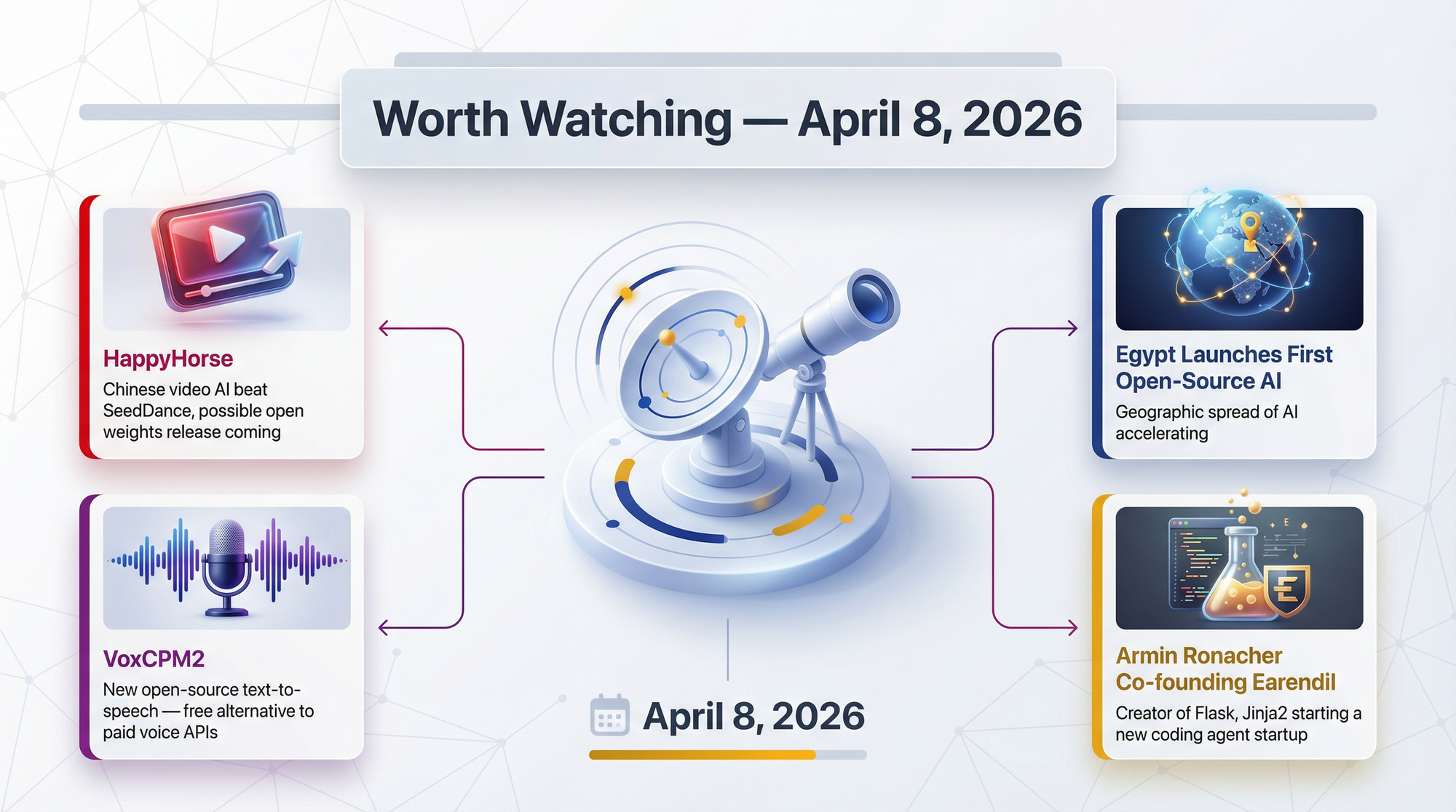
A Chinese AI model called HappyHorse reportedly beat SeedDance (one of the leading AI video generation models). A post on r/LocalLLaMA (35 upvotes) noted the team may release model weights publicly. If it does, it would be the highest-capability open video generation model available for local use - significant for creators who need local video generation for privacy or cost reasons.
VoxCPM2: A New Text-to-Speech Model Worth Testing
OpenBMB released VoxCPM2, a new open-source text-to-speech model available on Hugging Face. Community testing on r/LocalLLaMA (27 upvotes) described it as competitive with existing options. Text-to-speech is one of the areas where open models have consistently lagged behind commercial tools - VoxCPM2 may be narrowing that gap.
Try it: Live demo at huggingface.co/spaces/openbmb/VoxCPM-Demo. Model weights at huggingface.co/openbmb/VoxCPM2.
Egypt's First Open-Source AI Model
Horus, described as the first open-source AI model built in Egypt, was shared on r/LocalLLaMA today (270 upvotes). Available at tokenai.cloud/horus. The significance is less about Horus's current capabilities and more about the signal: AI development is no longer concentrated in a handful of US and Chinese labs. The geographic distribution is widening.
pi + Earendil: Armin Ronacher Enters the Coding Agent Race
The pi agent moving to Earendil means one of the most credible open-source figures in the Python ecosystem is now actively working on the AI coding tools problem. Given how Flask, Click, and Jinja2 evolved - starting as personal tools, becoming industry standards - this is a project to watch for developers who care about coding agent quality and openness.